The Difference in Use Demands
Epoxy flooring covers a wide range of applications, from residential garage floors to industrial warehouse slabs, and the systems used in each context differ in meaningful ways. Understanding how residential and commercial epoxy flooring differ helps both homeowners and business owners make more informed decisions and ask better questions before committing to a floor coating installation.
Epoxy Plus Flooring Solutions installs professional floor coatings for both residential and commercial clients across Michigan and Indiana. Here is a clear breakdown of how these applications differ and what each requires.
The Difference in Use Demands
The most fundamental difference between residential and commercial epoxy flooring is what the floor is asked to handle every day. A residential garage floor sees one to two vehicles, moderate foot traffic, periodic chemical exposure from oil and road salt, and the weight of stored items and lawn equipment. This is a demanding environment by the standards of a home, but it is mild compared to what commercial floors experience.
A commercial floor in a warehouse or manufacturing facility may handle dozens of forklift passes per day, pallet jack traffic across the full surface, heavy equipment loads, regular exposure to petroleum products and industrial chemicals, and foot traffic from multiple workers throughout extended operating hours. The cumulative mechanical and chemical stress on a commercial floor over a single year can exceed what a residential garage floor experiences over its entire service life.
This difference in demand is the primary reason commercial floor coating systems are specified differently from residential ones rather than simply using the same products at larger scale.
Product Specifications for Residential vs Commercial
Residential epoxy floor coatings installed by Epoxy Plus use professional-grade Penntek products that significantly outperform consumer-grade retail systems in bonding strength, film thickness, and durability. A standard residential specification includes a polyurea or epoxy base coat, a decorative flake broadcast for most applications, and a polyurea topcoat that provides UV stability, hot tire resistance, and chemical resistance appropriate for garage conditions.
Commercial specifications use products formulated for the specific demands of the application. High-traffic commercial floors often specify higher-build coating systems with greater total film thickness than residential applications. Chemical resistance requirements drive product selection in industrial settings where specific solvents, acids, or petroleum products are regularly present. Anti-slip aggregate broadcast into the topcoat is specified more commonly in commercial environments where wet conditions, liquid processing, or regulatory safety requirements make traction a priority.
Cure speed is a more significant factor in commercial specifications because downtime has direct operational cost implications. Polyurea and polyaspartic systems with same-day return-to-service capabilities are specified more frequently in commercial applications specifically because businesses cannot afford multi-day floor access interruptions.
Surface Preparation at Different Scales
The preparation principles that apply to every Epoxy Plus installation are identical across residential and commercial applications. Every surface must be ground to the appropriate profile, every crack and damaged area must be repaired, and every contamination source must be addressed before coating is applied. The standards do not change with scale.
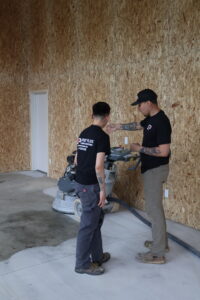
What changes is the equipment and method used to meet those standards at commercial scale. Shot blasting becomes the practical preparation method for large commercial floor areas where the efficiency advantage over grinding is significant. Commercial grinding equipment with larger planetary heads covers more area per pass than residential equipment. The logistics of preparing and coating a large commercial floor are substantially different from a residential garage even though the underlying preparation principles are identical.
Epoxy Plus provides both diamond grinding and shot blasting for commercial projects and selects the appropriate method based on the specific scope, conditions, and coating system requirements of each project.
Project Timeline Differences
A residential garage floor installation typically takes one to two days including preparation, coating, and initial cure time. A large commercial floor installation spans multiple days or weeks depending on the total area, the complexity of the preparation required, and whether phased installation is needed to keep portions of the facility operational during the project.
Phased commercial installations divide the floor into sections that are prepared and coated sequentially, allowing the business to continue operating in the areas not currently being worked on. Planning a phased commercial installation requires coordination between Epoxy Plus and the facility management team to minimize disruption while ensuring the full floor is completed to a consistent standard.
Cost Differences Between Residential and Commercial
Commercial floor coating installations cost more in absolute terms than residential installations because of the larger area, more demanding preparation requirements, higher-specification products, and greater labor investment involved. Per square foot pricing for commercial installations may be lower than residential in some cases because of the efficiency gains available at scale with appropriate equipment.
The investment calculation for commercial flooring differs from residential as well. A business evaluating a floor coating considers not just the upfront cost but the operational benefits of improved cleanability, reduced dust in the facility, improved lighting through better floor reflectivity, and the reduced maintenance cost over the coating’s service life compared to bare concrete.
Epoxy Plus Serves Both Residential and Commercial Clients
Epoxy Plus Flooring Solutions is a Penntek Certified Dealer serving residential homeowners and commercial clients across Michigan and Indiana with professional floor coating installations backed by a lifetime warranty. Our team has experience with the full range of applications from single-car garages to large commercial facilities and brings the same commitment to preparation quality and installation standards to every project regardless of size.
Contact Epoxy Plus today by phone (269) 325-9820 for a free estimate and let us help you choose the right system for your floor. You can also check out all of our Google Reviews and additional services.