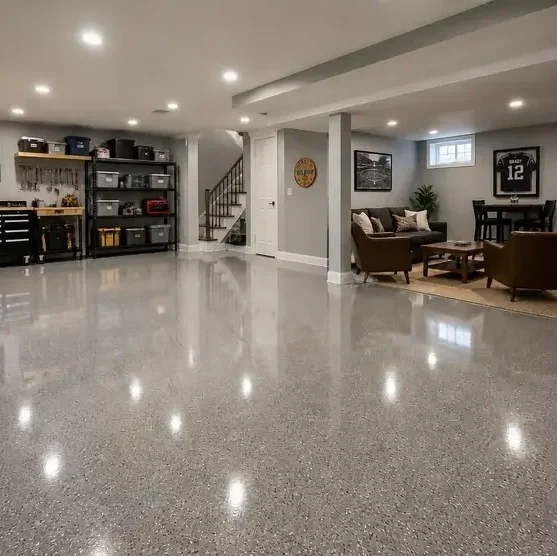
Can You Put a Floor Coating on a Basement Floor?
Basements are one of the most rewarding spaces to coat and one of the easiest to get wrong. Put a floor coating on a basement floor correctly, and the room goes from storage to living space. Get it wrong and the coating bubbles, peels, and has to be grinded off entirely.
The difference between those two outcomes usually comes down to a single factor, and it is one that most homeowners have never heard of. Putting a floor coating on a basement floor is entirely possible, but it requires answering a moisture question first.
Epoxy Plus Flooring Solutions installs floor coatings across Michigan and Indiana. This is what determines whether your basement is a candidate.
Moisture Decides Whether a Floor Coating on a Basement Floor Will Hold
A basement slab sits directly on soil. That soil holds water, and water vapor moves upward through concrete continuously unless something stops it.
Slabs poured with an intact vapor barrier underneath block most of that movement. Older homes frequently have no vapor barrier at all, or one that has degraded. In those slabs, moisture moves through the concrete and evaporates off the surface, which you normally never notice because nothing is in the way.
Put a coating over that surface, and the vapor has nowhere to go. Pressure builds beneath the coating and eventually pushes it off the concrete in blisters or sheets. This failure is not a product defect; it’s a slab condition that should have been identified beforehand.
How Moisture Testing Works
This is the step that separates a professional installation from a gamble, and it is not complicated.
A calcium chloride test measures how much moisture emits from the slab surface over a set period, typically 72 hours, expressed in pounds per thousand square feet per 24 hours. A relative humidity probe test measures conditions inside the slab itself by drilling to a specified depth and reading humidity at that level.
Coating manufacturers publish limits for their systems. If a slab tests above those limits, the options are a moisture-mitigating primer designed for elevated conditions, addressing the source of the water, or accepting that the slab is not a candidate.
A quick, unofficial version you can do yourself: tape a two-foot square of clear plastic sheeting tightly to the floor on all four edges and leave it for 24 to 48 hours. Condensation underneath or a darkened patch of concrete indicates moisture moving through the slab. This is not a substitute for a real test, but it tells you whether to expect a conversation about it.
A Floor Coating on a Basement Floor Requires Solving the Water First
If your basement takes on water, no coating fixes that. It is worth being blunt, because people occasionally hope a coating will function as waterproofing.
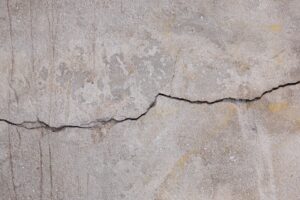
Water entering through walls, at the wall-floor joint, or up through cracks is a drainage problem. The usual solutions are exterior grading, gutter and downspout management, interior or exterior drain systems, and sump pump capacity.
Coat first and you seal a wet slab, which produces failure faster than doing nothing. Address drainage first and the coating goes down onto a slab that will hold it.
Why a Floor Coating on a Basement Floor Works Well
Once moisture is settled, basements are excellent candidates for coating and offer some advantages over garages.
There is no UV exposure, so color stability is a non-issue and standard epoxy systems remain viable where they would not be elsewhere. Temperature swings are far smaller than in an unheated garage, which reduces slab movement. And the surface is easier to keep clean than bare concrete, which sheds dust continuously and is a real nuisance in a finished space.
Coated basement floors also handle the specific failures basements are prone to. If a water heater lets go or a washing machine hose fails, a coated floor cleans up in a way that carpet, laminate, or bare porous concrete does not.
Choosing a Floor Coating for a Basement Floor
The system depends on how the space will be used.
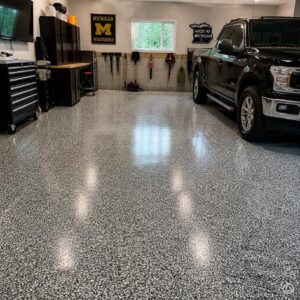
Flake systems are the most popular choice for finished basements. The texture provides slip resistance, which matters on a floor that may get wet, and the visual pattern conceals imperfections in an older slab better than a solid color would.
Metallic systems suit basements built as entertainment or bar spaces, where the floor is meant to be a feature. Solid color works in utility areas, laundry rooms, and workshops where function is the priority.
Polyurea and polyaspartic systems bring one advantage that matters specifically in a basement: fast cure times mean less time with the space unusable and less time with coating odor in a room that has limited ventilation.
Preparation in a Confined Space
Basement installations carry practical considerations a garage does not.
Surface preparation still requires mechanical grinding, and grinding indoors requires proper dust containment and vacuum systems. A contractor who plans to acid-etch a basement floor instead of grinding it is cutting the corner that matters most.
Access is also a factor. Equipment has to get down a staircase, which affects what can be used and how long the job takes. This is a normal part of basement work for a crew that does it regularly.
Ventilation matters for both the crew and the household during installation, and fast-curing systems reduce how long that is a consideration.
Find Out Whether Your Basement Is Ready
Whether your slab can hold a coating depends on its moisture conditions, its age, and its history. Those are things we assess on site, and moisture testing is a standard part of the evaluation rather than an upcharge.
Epoxy Plus Flooring Solutions is a Penntek Certified Dealer installing flake, solid color, metallic, and polyurea systems across Michigan and Indiana, with every installation backed by a lifetime warranty.
Contact Epoxy Plus today by phone (269) 325-9820 for a free estimate and let us help you choose the right system for your floor. You can also check out all of our Google Reviews and additional services.