What Floor Coating Works Best for a Restaurant Kitchen?
A commercial kitchen floor deals with hot grease, constant water, dropped equipment, and a crew moving fast during a rush, conditions that would wear through a standard coating within a year or two. A restaurant kitchen floor coating has to be specified for that reality specifically, not adapted from a garage or retail system after the fact.
Epoxy Plus Flooring Solutions installs floor coatings across Michigan and Indiana, including commercial kitchens. Here is what actually matters for this environment.
Slip Resistance Is the First Requirement, Not an Afterthought
Kitchen floors get wet constantly, from mopping, spills, condensation, and food prep, and a floor that is not built for that combination is a real safety liability.
Aggregate texture broadcast into the topcoat creates mechanical grip that holds up even when the surface is wet with water or grease, which is different from texture that only helps with plain water. The level of grit matters too. Enough for genuine traction, without being so aggressive that it becomes difficult to clean or catches debris.
A common claim worth clearing up: many sites state that OSHA requires a specific slip resistance number, usually 0.5 coefficient of friction, for commercial floors. OSHA itself has confirmed this is not accurate. The 0.5 figure comes from a nonmandatory appendix in a proposed rule that was never finalized, not from any binding OSHA standard. What OSHA does require, under the general duty clause and its walking-surface regulations, is that floors be kept reasonably free of slip hazards, without mandating a specific tested number. A contractor who quotes you a hard OSHA number as law is repeating a common misunderstanding rather than current regulation.
That said, specifying real, tested slip resistance is still the right move for a kitchen floor regardless of what is technically mandated, since the practical risk of a slip in a working kitchen is entirely real.
Chemical and Grease Resistance
Kitchen floors face a chemical load that few other commercial spaces match.
Grease, oils, food acids, and industrial cleaning chemicals all contact the floor regularly, and each can attack certain coating chemistries over time. Polyurea and polyaspartic systems generally hold up well against this range, resisting the combination of grease breakdown and repeated harsh cleaning that a kitchen floor endures daily.
Restaurant Kitchen Floor Coating: Fast Cure Time
A restaurant loses revenue for every day the kitchen cannot operate, which makes installation speed a real financial consideration, not just a convenience.
Polyurea and polyaspartic systems that install in a single day, or overnight for a smaller kitchen, let a restaurant reopen far faster than a traditional epoxy system requiring multiple days between coats and cure time. For a working kitchen, that difference can be the deciding factor in system selection on its own.
Drainage and Sloping
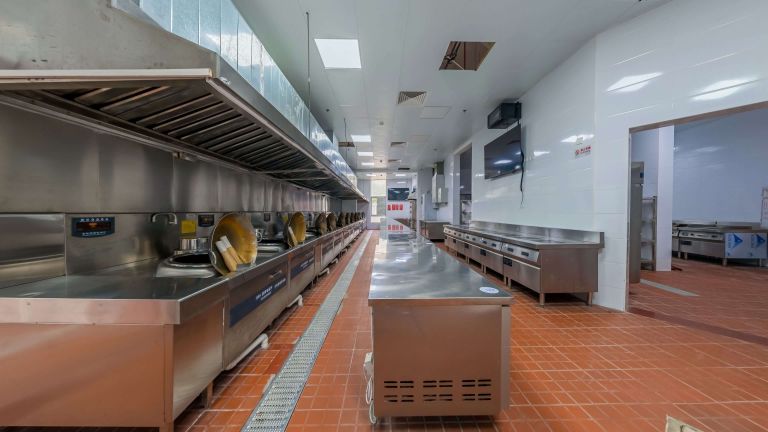
Commercial kitchens are typically built with floor drains and intentional slope to manage the water and cleaning fluid that constantly hits the floor.
A coating has to be installed with that existing slope preserved, or in some cases corrected, so water actually reaches the drain rather than pooling. This is a detail that matters more in a kitchen than almost any other commercial application, since standing water on a kitchen floor is both a slip hazard and a sanitation concern.
Seamless Application for Sanitation
Health code compliance is a real factor in kitchen flooring decisions, separate from durability.
A seamless coated floor eliminates the grout lines and seams that trap grease and bacteria in traditional tile, which is a genuine sanitation advantage inspectors and health departments recognize. Coved base, where the coating curves up the wall at the floor line instead of meeting it at a sharp angle, eliminates another hard-to-clean corner and is a common addition in commercial kitchen installations specifically.
Color and Visibility Considerations
A few practical choices affect daily kitchen operation beyond pure performance.
Lighter colors show dirt and grease buildup more readily, which some operators actually prefer since it makes cleaning needs visible immediately rather than hiding buildup. High-contrast color zones can mark walkways or hazard areas, similar to how color coding works in industrial settings.
Installing a Restaurant Kitchen Floor Coating on a Deadline
Installation timing is its own consideration for a business that cannot simply close for a week.
Overnight or off-hours installation is common for restaurant work specifically, scheduled around closing time so the kitchen reopens for the next service. This is another area where fast-curing systems have a real practical advantage over traditional epoxy.
Getting the Right System for Your Kitchen
A restaurant kitchen floor coating has to balance slip resistance, chemical durability, drainage, and sanitation requirements simultaneously, which is a more demanding specification than most commercial spaces require.
Epoxy Plus Flooring Solutions is a Penntek Certified Dealer installing commercial floor systems across Michigan and Indiana, with every installation backed by a lifetime warranty.
Contact Epoxy Plus today by phone (269) 325-9820 for a free estimate and let us specify the right system for your kitchen. You can also check out all of our Google Reviews and additional services.