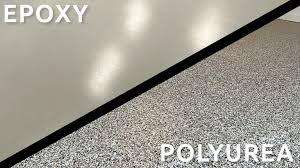
What Is the Difference Between Epoxy and Polyurea Coatings?
Most people shopping for a garage or shop floor use the word epoxy to mean any coated concrete floor, the same way people say Kleenex for tissue. It is a reasonable shorthand, but it hides a real distinction, and understanding the difference between epoxy and polyurea changes which questions you ask a contractor.
The two are different chemistries with different strengths. One has been the industry standard for decades. The other has largely replaced it for residential and light commercial work over the past fifteen years or so, for reasons worth knowing before you sign anything.
Epoxy Plus Flooring Solutions installs floor coatings across Michigan and Indiana. Here is a plain comparison of the two.
What Epoxy Actually Is
Its strengths are real. Epoxy builds thickness well, which makes it useful where a heavy-duty wear layer is needed. The bond to properly prepared concrete is strong, and the cured film resists a wide range of chemicals. Material costs run lower than the alternatives, and decades of documented performance back it up in industrial settings.
What Polyurea Is
Polyurea is a different chemistry that cures through a much faster reaction and produces a flexible rather than rigid film. Polyaspartic is a closely related material, and in practice most professional systems use both, typically a polyurea base coat with a polyaspartic topcoat.
Polyaspartic is a closely related material. Most professional systems use both — a polyurea base coat under a polyaspartic topcoat.
The Difference Between Epoxy and Polyurea in Cure Time
This is the distinction customers notice most.
Epoxy cures slowly. A typical residential installation requires multiple days, with waiting periods between coats and a further wait before vehicles can return to the space. A full week before a garage is back in normal use is not unusual.
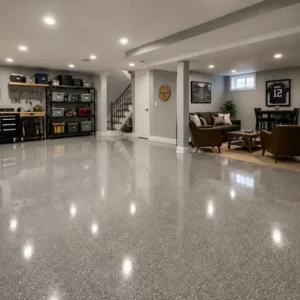
Polyurea cures in hours. Coats can be applied the same day, and most residential installations are completed in a single day, with foot traffic returning that evening and vehicles the following day.
For a homeowner emptying a garage or a business shutting down a work area, that difference is not a minor convenience. It is often the deciding factor.
Flexibility and Cracking
Concrete moves. It expands in heat, contracts in cold, and shifts as the ground beneath it settles. In Michigan and northern Indiana, freeze and thaw cycling puts slabs through that movement dozens of times each winter.
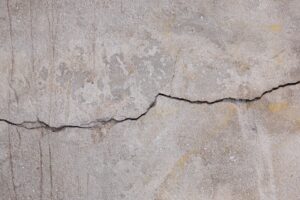
A rigid coating has limited ability to move with the slab. When the concrete shifts more than the coating can accommodate, the coating cracks or delaminates. A flexible coating absorbs that movement and stays bonded.
A rigid coating cannot move much with the slab. When concrete shifts further than the coating can absorb, the coating cracks or lets go.
UV Stability and Color Change
Standard epoxy ambers under ultraviolet light. A garage with the door open through the day, a floor beside a large window, or any exterior application will yellow over time. The protection remains, but the appearance changes.
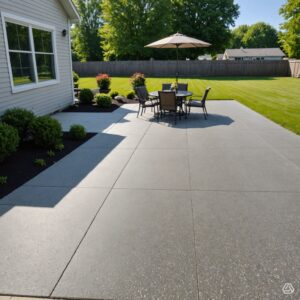
Polyurea and polyaspartic systems are formulated for UV stability and hold their color. For anything that sees sunlight, including patios and pool decks, this alone rules epoxy out.
Temperature Range During Installation
Epoxy requires a fairly narrow temperature window to cure correctly, which limits when it can be installed in an unheated Michigan garage. Cold slows or prevents proper curing.
Polyurea tolerates a much wider range of installation temperatures, which extends the working season considerably in this climate and means a coating project is not automatically a summer-only proposition.
The Difference Between Epoxy and Polyurea in Cost
Polyurea material costs more than epoxy. That is straightforward, and any contractor telling you otherwise is not being accurate.
Compare total cost over the life of the floor instead. A cheaper coating that fails in five years is not cheaper at all. Removal is its own expense, because a crew has to grind the old material off before anything new goes down.
Faster installation also carries value that does not appear on a materials invoice, particularly for a business that would otherwise lose days of use of a space.
Where Epoxy Still Makes Sense
This is not a case where one product wins everywhere.
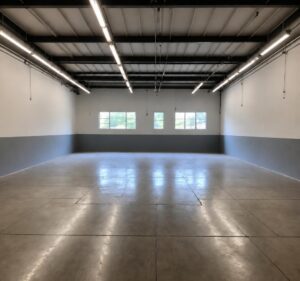
Epoxy remains a strong choice for interior industrial floors with no UV exposure. It also suits applications needing real coating thickness, some chemical containment environments, and large projects where material cost drives the decision.
An honest contractor specifies for the conditions rather than defaulting to whatever they prefer to install. If someone tells you one product is correct for every floor, that is a sales position rather than a technical one.
What Epoxy Plus Installs and Why
Epoxy Plus Flooring Solutions is a Penntek Certified Dealer, and we install polyurea and polyaspartic systems for most residential and light commercial work because of the flexibility, UV stability, and single-day installation those systems provide in a freeze-and-thaw climate. We install epoxy systems where the application calls for them.
Every installation is backed by a manufacturer’s lifetime warranty, and our team assesses your concrete, your moisture conditions, and how the space is actually used before recommending a system.
Contact Epoxy Plus today by phone (269) 325-9820 for a free estimate and let us help you choose the right system for your floor. You can also check out all of our Google Reviews and additional services.